(Criterion/Kanopy/VOD/Vudu/YouTube)? Robert Downey, Sr. passed away this week at the age of 85. While his son is mostly known for more accessible fare, Downey Sr. was an anarchic indie filmmaker, and there’s no better example of his cinematic skills than PUTNEY SWOPE.
PUTNEY SWOPE is a nihilistic indictment of Madison Avenue, American capitalism and everything it’s created (including filmmaking and anti-American capitalist revolutionaries), while also being damn funny and inventively shot. The faux-commercials it features are perhaps only rivaled by ROBOCOP (1987) or the best of Adult Swim. For instance:
I need to note that this is an incredibly insensitive film in ways I haven’t quite managed to personally reconcile — after all, it’s a film written and directed by a middle-aged white man about a Black man breaking the system — but it is also endlessly fascinating.
(VOD)? FLASHFORWARD was a post-LOST high-concept ensemble show (based on Robert J. Sawyer’s novel of the same name) helmed by David S. Goyer (who has penned everything from DARK CITY to BATMAN V SUPERMAN). Due to reasons that are (very slowly) exposed over the show’s first season, every human in the world blacks out for 137 seconds which, as you can imagine, was very unfortunate for anyone in an automobile or airplane at the time. However, the majority of folks encountered a vision of what appears to be their life in six months, hence the title of the show. Notably, some people didn’t see anything, and some of those people believe that means they won’t be alive in six months, and more than a few of those folks -do not- react reasonably to that thought.
It features Mark Benford (Joseph Finnes, popular for the best-forgotten SHAKESPEARE IN LOVE) as focal character FBI agent investigating ‘the incident’, and he’s also a recovering alcoholic. (In his flash-forward, he’s fallen off the wagon). Mark’s FBI partner is Demetri Noh (John Cho, HAROLD & KUMAR, the rebooted STAR TREK films, and also pops up as Billy Eichner’s boyfriend on the previously recommended DIFFICULT PEOPLE). Courtney B. Vance (THE PEOPLE V. O.J. SIMPSON) plays the FBI director overseeing Mark and Demetri, and Mark’s wife is surgeon Dr. Olivia Benford (Sonya Walger, one the best parts of LOST). LOST’s Dominic Monaghan portrays a scientist (which is a bit of a stretch, James Callis (the rebooted BATTLESTAR GALACTICA but also the previously recommended 12 MONKEYS TV series) is peppered into a few eps as are Gabrielle Union and Annabeth Gish. Also, sadly-departed magician Ricky Jay brings his skills to a handful of episodes.
So, FLASHFORWARD has an intriguing concept, a versatile storytelling engine, a fantastic cast, and a significant budget, so you probably expect me to write that it’s an underrated one-season wonder.
You would be wrong.
This is not a great show. It spends too much time spinning its wheels, the characters are extraordinarily one-dimensional and uninspired, and the dialogue is very clunky. It’s not a terrible show, but it never finds its footing, and I doubt if it would have even if it had been renewed.
So, why am I recommending it? I’m recommending it solely for one supremely stupid recurring exchange between husband and wife Mark and Olivia that is clearly intended to be a sarcastic-but-cute inside joke:
“I hate you.”
“I hate you too.”
I have no idea whether this is in the original novel. It does seem like a lift from WHEN HARRY MET SALLY but, when I watched the series with my wife, we had forgotten about that comedic bit. The same exchange also occurs between Alain Delon and Ann-Margret in ONCE A THIEF (1965) and — when delivered by them — it’s comedic and even sexy.
Fiennes and Walger — while normally being very winsome actors — can’t pull it off. Sadly, they have little romantic charisma together, but also it’s just poorly framed because they aren’t complex characters.
To the show’s credit, it’s worth noting that Olivia’s flash-forward is that she’s with another man, so it’s a bit of unsubtle foreshadowing, but it still rang hollow when we watched it when it was first broadcast.
Since then, my wife and I often jokingly bring up that poorly executed exchange so, in a way, it was inadvertently effective writing. While it’s an exchange that has been handled far better in more memorable works, it’s FLASHFORWARD’s use of it that’s become our inside joke.
(Disney+) (Apologies in advance for the length of this post.) Yeah, I know that this is the last show I need to go to bat for, but still, I’m gobsmacked by how much I’ve enjoyed it. I was a late-bloomer when it came to reading comic books. My inaugural comic was Marvel’s SILVER SURFER #50 (written by Jim Starlin — without whom NONE of Phase 3 Marvel would exist — and penciled by Ron Lim), I was barely a teen and it caught my eye solely because of the gimmicky platinum foil cover (ooh, shiny!) but when I flipped through it at my local drug store — yep, I’m old enough to have purchased comic books via local drug stores on a spindle-rack — I was fascinated with the Silver Surfer’s interiority. I thought to myself: ‘Wait, you can tell this sort of existential story through comics and so-called super heroes? I thought comic books solely consisted of people endlessly punching each other.’
(An aside: It’s no surprise that I’d later go on to fall in love with the films of Jean-Luc Godard, who would explicitly reference the SILVER SURFER in his movies.)
Sadly, as Marvel as pivoted from print to film, most of their movies have solely consisted of people endlessly punching each other, usually in non-descript factory warehouses. I won’t begrudge anyone for enjoying the MCU films but, apart from extreme examples — such as THOR: RAGNAROK and BLACK PANTHER — I’ve found them to be rather lifeless works.
So, when I’d heard that Marvel was finally folding TV into the MCU, I simply shrugged. (For the record, I adored AGENT CARTER, and the first season of JESSICA JONES is a fascinating scrutiny of abuse. Sadly, neither of those are technically MCU works.) However, WANDAVISION showed that they were taking far more risks by inventively showcasing the inner turmoil of a woman dealing with grief. I have yet to see THE FALCON AND THE WINTER SOLDIER, but have read that it’s a damning indictment of U.S. policing and being Black in America. Now we have LOKI, which is explicitly about an irresponsible narcissist reckoning with his actions and confronting himself (in more ways than one). It’s a surprisingly existential story and, yes, punches are thrown in just about every episode, but those feel more like MCU fan-service. The real hits that land are the show’s focus about one’s guilt and fatalism than spectacle. There’s an interiority to these MCU TV shows that’s lacking in the films.
As if that’s not enough, the show is pure object-porn if you love a 1970s sci-fi aesthetic. It also helps that LOKI has more than a few 12 MONKEYS-ish devices where there are a number of folks solely focused on literally blowing up time. This is a show that isn’t afraid to take smart swings, to upend what you expect from a ‘comic book TV show’, and it keeps you guessing in a number of thrilling ways. For a summer TV show, it’s surprisingly cerebral sci-fi, but never off-putting.
Oh, and there’s the cast: Tom Hiddleston is obviously brilliant, and he’s joined by Owen Wilson as a perfect buddy-cop (always has been, and yes, they confront the cop question you may have in your head right now due to the last year), Sophia Di Martino (from the severely underrated series FLOWERS) is a revelation as the headstrong Sylvie, and Wunmi Mosaku (watch HIS HOUSE, folks!) thunders through every scene she’s in. Gugu Mbatha-Raw seems a bit wasted in her role, but there’s one more ep left, so fingers crossed she gets more to do.
At only six episodes — again I’m only five eps in — it feels perfectly paced. It’s a cracking good time and has reminded me that serialized sci-fi is alive and well, even if it’s in Disney’s hands. I rarely want to write about a show in-progress, but, well, here we are. My only quibble is the usual sexlessness of the Marvel/modern Disney universe, because after watching one scene I turned to my wife and asked: “Am I terrible person if I want them to fuck?” (You’ll know the scene when you see it.) Spoiler alert, but not really because it’s Disney: you get a hand on a shoulder and that’s fucking it.
A few passing remarks in reaction to podcasts that have discussed the show:
I also love Indiewire’s MILLIONS OF SCREENS — I’ve been following Libby Hill for years, and she’s always been extraordinarily insightful — and I really thought they’d be 100% behind this. They were not. I understand why — they expect more from TV, and yeah, given Marvel’s resources, they could be far more inventive with their properties — but I’m more than okay with the mini-series bits that Marvel is serving up, because it gives creators far more latitude than the filmmakers, and what we are getting is actually interesting and engaging which, again, is far better than the bulk of the films! (Sorry, not sorry.)
(DVD) I’m keeping this to my most memorable MAX HEADROOM ep, but I loved all of them. I know most folks are only familiar with the character Max Headroom (performed in extreme makeup by Matt Frewer, who doubles as televisual news journalist Edison Carter) from the Coke commercials, or maybe from pseudo-characters from satirical cartoons like DOONESBURY or BLOOM COUNTY.
If you’re of a certain age and watched TV, you can’t forget that brilliant neon-lined backdrop. If you aren’t familiar with the show: Edison Carter is an activist journalist for Network 23 in a cyberpunk near-future. When he’s almost killed upon doing legwork for an investigative story that involves Network 23’s potentially lethal blipverts, the network puts a hit out on him via a hacker, who triggers a parking garage lift as Edison’s trying to escape some cronies, and he flies face-first into a parking garage hazard sign with the words ‘MAX HEADROOM’. Said hacker then reconstructs Edison’s persona from a digital copy of Edison’s brain to continue non-Network 23-related reports for the network, and MAX HEADROOM is born. (Edison survives to tell the tale, but is now stuck with a sarcastic, extremely popular but very extreme digital copy of hisself.)
I didn’t grow up with the even-more-forgotten MAX HEADROOM late-night show that Frewer helmed in Australia, but I watched the TV movie via LaserDisc when I was a youth and it was enough of a revelation that I named our newly acquired yellow-and-black-striped cockatiel Max after the show.
(Yes, I grew up with birds and LaserDiscs, and rode horses. I fully realize now that my youth was off-kilter.)
There are more intriguing episodes of MAX HEADROOM, but -Dieities- is a very Cronenberg-ian episode of TV. It’s about televangelists and the falsity of ‘mind-storage’ (which is obviously self-reflexive, given his Max Headroom TV-centric AI persona). Oh, and there are a number of vaguely hidden riffs on Scientology. It’s especially high-concept for a show that repeatedly took big swings.
Unfortunately, it’s not available to stream anywhere, but the DVD box set is readily available. In lieu of a trailer, here’s a link to the TV film:
“Oh God, he’s been in the Dobie Gillis file again.” (A quote from -Dieties-, not from the pilot. As someone who saw a number of Dobie Gillis films in summer day camps, I felt very seen.)
(Pluto/VOD) There are movies that have musical moments, there are musical movies, and then there are film musicals. I find that differences are somewhat slight: musical moments are films that have a handful of scenes where the characters burst into song, usually to a well-recognized pop culture song, to underpin whatever emotional state they’re feeling. (Think the jukebox moment in SOUTHLAND TALES when Justin Timberlake lip synced to THE KILLERS’ -I Got Soul- which I both love and hate that I love.) Musical movies are adaptations gussied up to conform to the needs of the film viewer. (I’m trying to keep to modern references, so: Tom Hooper’s LES MISERABLES or, uh, CATS* but also previously recommended, and non-modern, THE MUSIC MAN.)
Then there are film musicals, which aren’t adaptations, and often are labeled as ’rock opera’, despite often being neither. They follow the scripted structure of a musical, and then they just film it. It’s too grandiose to fit within the required guidelines of a Broadway music, but the creators -love- traditional musical narrative structure, and are dead-set on realizing their creation. They’re rarer because they’re often fan efforts. For every ROCKY HORROR PICTURE SHOW, we also get five REPO! THE GENETIC OPERAs**.
ANNA AND THE APOCALYPSE definitely falls in the latter camp, and emphasis on camp. It’s based on the short film ZOMBIE MUSICAL (but I’ll warn you that it’s definitely an early draft of a feature film) — and it toys with the format, including one musical number well-worth the price of admission where lead Anna (a very elastic DICKENSON’s Ella Hunt) and her best friend John (Malcolm Cumming) obliviously sing through zombie anarchy due to a transformative evening which, yes, cribs from SHAUN OF THE DEAD and Zack Synder’s DAWN OF THE DEAD but manages to do its own thing. I do wish the music was stronger though — the songs are fine but, apart from a few exceptions, they’re mostly forgettable — but it’s a fun time, especially if you’re into both comical horror and musicals.
Lastly, if you’re interested in musical narrative storytelling, Jack Viertel’s THE SECRET LIFE OF THE AMERICAN MUSICAL is a revelation. He does an amazing job of deconstructing how musical narratives work in ways that will blow your mind.
Trailer:
* Sorry not sorry, but I find the film far more watchable than the stage production, even though Tom Hooper should never have been given this project.
** For what it’s worth, I do admire the hard-scrabble pluck of REPO!. I sat in on a Q&A where the writer and director went into detail as to how they finagled specific SAW sequel scenes just so they could film specific REPO! scenes for free, and good for them for realizing their vision through whatever means necessary!
It’s a sad day: Richard Donner has passed away. While he’s rightfully best known for SUPERMAN, he spent -a lot- of time directing television, including an ep of previously recommended ROUTE 66, eps of TALES FROM THE CRYPT, even eps of THE LORETTA YOUNG SHOW, but most memorably, some of the best episodes of THE TWILIGHT ZONE. Consequently, I’m re-posting a slightly tweaked version of my prior recommendation of one of his lesser-known THE TWILIGHT ZONE eps:
(Hulu/Paramount+/VOD) This episode of THE TWILIGHT ZONE is rarely included in best of lists, which is fair — even if it’s the last-filmed ep -and- directed by Richard Donner — as its story is a bit strained, even by TWILIGHT ZONE standards. Floyd Burney, known as the “Rock-A-Billy Kid” (Gary Crosby), is on the prowl for a new song in a small, unnamed town. He overhears a woman singing and follows her voice as she repeats the refrain: “Come wander with me love / Come wander with me / Away from this sad world / Come wander with me”
The woman introduces herself as Mary Rachel (Bonnie Beecher) and is reluctant to part with the song, but Floyd is insistent. Matters escalate quickly as the rest of the song is revealed.
While the episode is a bit clunky, it’s the song that makes it memorable. -Come Wander With Me- is a brilliantly haunting ballad and, even though the song was never written or recorded in full, a number of musicians, such as Émilie Satt and British Sea Power, have covered it over the years.
(YouTube) I am a big fan of rapper DESSA, but hearing her daily throughout Turner Classic Movies’ June programming trailers, which include a lot of Hitchcock and also feature her original recording of -Dixon’s Girl- drove me a bit nuts. (I believe the inclusion of the song is a shoutout regarding screenwriter Alma Reville, Hitchcock’s wife and often-neglected creative partner.) I’ve had the line ‘call me up, day or night: free drinks and bad advice’ stuck in my head for roughly thirty days, as TCM plays in the background of our home practically 24/7.
My way of shunting out my obsessions is to write about them so: it’s a perfect song with a ton of great hooks and samples, and on top of that highlights not only the patriarchal nature of the the music industry, but also the women complicit in keeping the status quo.
The original video is available here:
And there was a symphonic version recorded in 2019 that I would have loved to see live:
DESSA also just released six singles within a six months, complete with videos, which comprise the IDES EP, all available via her site.And she’ll be touring soon-ish! We saw her at local indie rock tavern Schubas several years ago, and she’s absolutely blistering live.
(HBO MAX/Netflix/VOD) I’m not big on possession films (although I have seen, and enjoyed, most of THE EXORCIST films) and I have no love for the pristine, far-too-clean look of most mainstream modern horror movies, including THE CONJURING films, but THE CONJURING 2 really impressed me. Its camerawork, blocking, production design, and visual scene construction are absolutely fantastic, plus I can’t help but adore seeing a loving, middle-aged couple on-screen.
Vera Farmiga and Patrick Wilson do a lot of the leg work that make these films work. While their characters don’t break any gender norms — he’s very obviously the muscle and she’s the empath — it’s a welcome change from the world-weary, loner protagonist. (That said, I don’t have any interest in discussing the real-life analogues, either them, or the cases they seek out.)
I’ll note that I don’t quite understand why this is a film franchise eight films deep. (Also, I haven’t watched the side-films, such as THE NUN or ANNABELLE.) This feels like it should be TV series, even down to the haunted item collection. (See: FRIDAY THE 13TH: THE SERIES or WAREHOUSE 13.) FOX turned THE EXORCIST into a brilliant TV anthology series (although it’s a shame no one tuned in to watch so it only lasted two seasons). Film or TV, THE CONJURING 2 is an entrancing work and, while it could have been tightened up a bit — seriously, possession films do not need to run over two hours — it does indulge in some very fun-but-frivolous scenes that I quite enjoyed, such as Patrick Wilson recreating an Elvis song.
I watch more horror films than the average filmgoer, and I read a fair number of thrillers and murder mysteries, but I’m rarely disturbed by them. Call it desensitization or practiced separation, but all too often I see it as an academic matter.
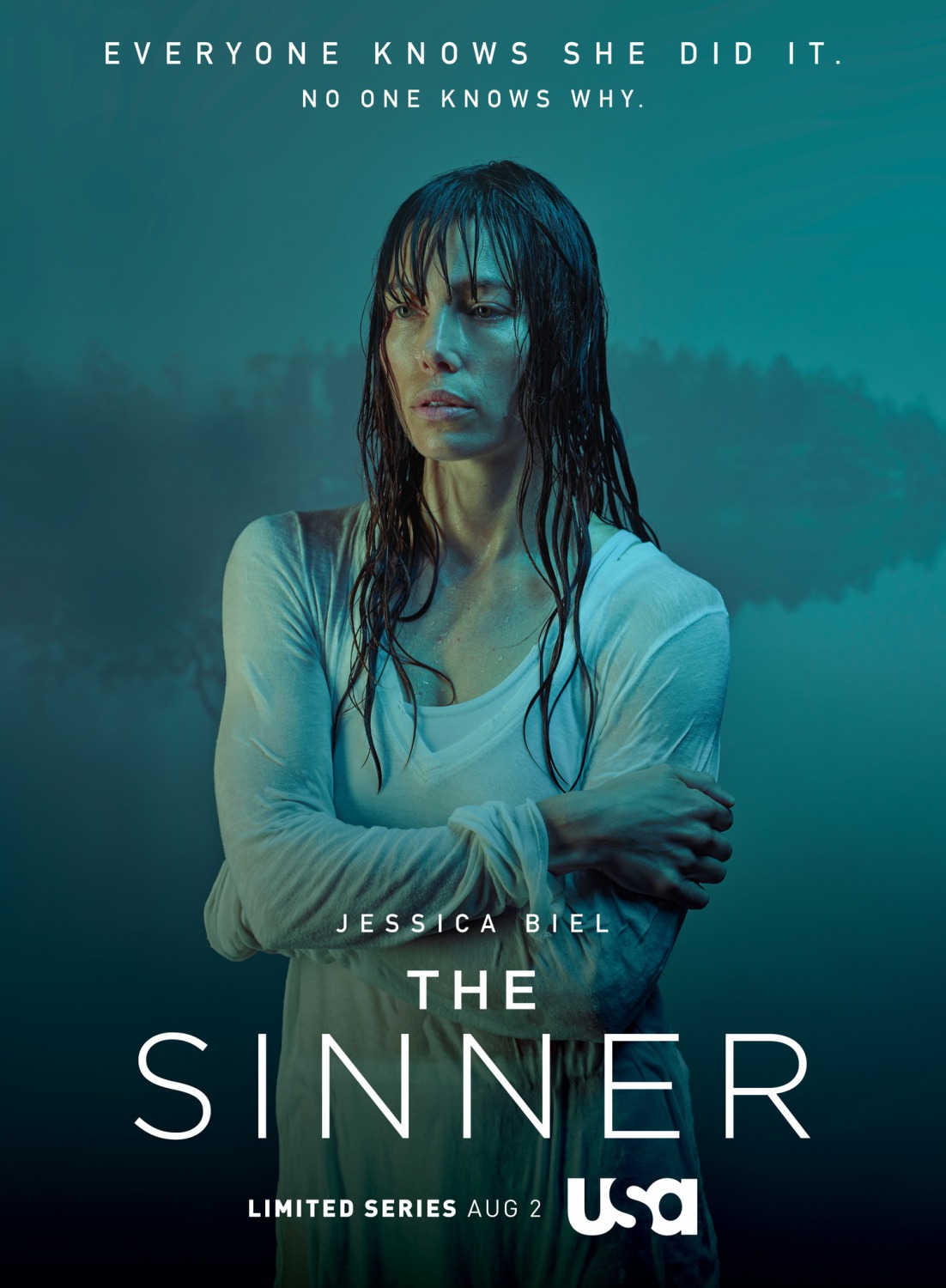
THE SINNER S1 fucked me up. It’s a nasty, heartbreaking story but, more than anything else, it’s an extraordinarily cruel tale of abuse, one that I can rarely verbally discuss without finding a bit of a hitch into my breath.
THE SINNER S1 is about a woman, Cora (Jessica Biel), who goes to the beach with her husband and toddler, who then kills a man kissing a woman in broad daylight, amongst a number of witnesses. Cora is arrested, confesses to the killing, and Detective Harry Ambrose (Bill Pullman) gets assigned to the case and he becomes obsessed with deducing exactly why she killed this man.
The first season of the show is based on the 1999 novel of the same name, written by Petra Hammesfahr, widely considered Germany’s Patricia Highsmith. (I disagree with that comparison because, for better or for worse, there will never be another Patricia Highsmith.) While the show hews relatively closely to the book, it does drop some of the darker and stranger elements* while also modernizing the material, tweaking the locale, and changing one noteworthy song.
I won’t go into the hows or whys, but it cuts to the quick of trauma in a way that made me very uncomfortable, but can’t help but extoll. Once I finished the final episode, I immediately started rewatching it, not to see how the pieces added up, but to examine how they pieced Cora’s character together. It’s a surprisingly controlled effort from first-time show runner Derek Simonds, one to be applauded.
The following second and third seasons are completely separate cases and allegedly, apart from Detective Ambrose and his private life, have nothing to do with the first season or the novel. (I have not seen them, so I can’t say for sure.) A fourth season is in the works.
* Yes, the book is quite a bit darker than the series. I read the novel a good year or so after watching it, so I’d forgotten what quite what the show excised, but it was probably for the best. For a list of differences, check out the following spoiler-filled article.
(DVD/Blu-Ray) Back in May I posted about MUBI teaming up with the Music Box Theatre — a Chicago arthouse theater — for a two week ‘Back on the Big Screen’ event. (The previously recommended MATINEE was also part of the programming.) The sole film I didn’t recognize was Ming-liang Tsai’s GOODBYE, DRAGON INN, so I immediately bought a ticket without reading anything about it, apart from a sentence fragment I accidentally skimmed while patching up my Music Box Chrome extension: “It’s the final show at Taipei’s enormous Fu Ho movie palace”
The screening was surprisingly well-populated for a Monday matinee in early June — a good sixty, seventy or so folks, all vaguely socially distanced and mostly masked. Maybe more? I’m poor at eyeballing an audience but, given that two weeks prior, I was the sole person at a Wednesday matinee, it was a solid crowd.
That said, based on what I overheard upon exiting the film, a good two-thirds of them walked away feeling disappointed, expecting something far more gripping or narratively substantial than they received. Obviously, I don’t hold the same opinion.
GOODBYE, DRAGON INN is first and foremost a mood piece. Apart from the film that plays throughout the bulk of the piece (DRAGON INN, 1967), there’s very little dialogue in the film. A young man enters a film palace screening its final film before closing. A black cat scampers down the hallway. A woman with leg braces clomps around, doing her last daily rounds, stepping across leaky spots in the deteriorating building. She brings food up to the projectionist, who is missing from the projection booth. Said young man encounters a small number of individuals during the screening, some who may be real or may be ghosts. One particularly memorable individual is a woman who loses her shoe while endlessly cracking enough sunflower seeds to flood the theater stairway. The young man leaves. The woman closes up shop. The projectionist leaves. The woman follows.
In other words, GOODBYE, DRAGON INN is comprised of atmospheric vignettes of theatergoers and theater operators. It has the barest of narrative arcs, and few specifics about the characters that inhabit the theater, and even those specifics are inferred instead of explicitly stated. It’s pure cinema in that it shows, it doesn’t tell, which is obviously why it was brilliantly part of MUBI’s programming. While it’s not to everyone’s taste — after the film, I grabbed a drink outside at a local bar and couldn’t help but hear two folks bitch and moan about how boring the movie was — this sort of visual longform work is catnip to me, and I feel very lucky to have been able to attend the screening, and very thankful that MUBI did program it instead of a film that may have been more popular, but certainly would have been far less interesting.
(This is yet another case where the film is not available to stream, and hunting down a copy for a region one player can be costly and very difficult, so I’ll wink and suggest a YouTube search instead.)