I have to admit that, prior to finding out about a film screening of an adaptation of this videogame, I had never heard of DETENTION.
DETENTION is a very SILENT HILL 2-esque guilt-centric 2D horror point-and-click Taiwanese game that takes place during the White Terror which dovetailed with the U.S.’ Communist witch-hunts, except that instead of being blacklisted, you were abducted and killed.
DETENTION takes place in the mid-60s, in a Taiwanese high school and is relatively straight-forward, as adventure games gome. I’d love to discuss some of the specifics, but sadly, spoilers.
Yes, the translation work is not great — it’s extremely clumsy — but the original dialogue may have been overwrought from the get-go. Yes, the artwork is a bit flat, and the animation is stilted. Sure, it often feels like a student game.
Nonetheless, it’s an amazing piece, buoyed by it being a love letter to the political and cultural shifts with Taiwan. It’s utterly earnest and enlightening and engaging, and uses horror motifs and self-reflection in a way that few games do. It’s a bold piece, and one that doesn’t demand much of your time — you can finish it in under four hours — and it’s well-worth that time.
HEALTH is a surprisingly popular electronic band that has a sound and aesthetic more suited for dark late-90s/early naughts clubs than, well, Spotify. They double down on that idiosyncratic nature with a number of their videos, which are firmly ensconced in both the horror genre and art film worlds.
DIE SLOW (2009):
While the video for DIE SLOW fully leans into sensationalism, given that it depicts a bloodletting frenzy, visually its use of framing and reframing (and more reframing) reminds me more of Peter Greenaway’s PROSPERO’S BOOKS, and its editing is extraordinarily taut.
WE ARE WATER (2009):
Immaculately produced, but a bit squicky — if you’re familiar with SLEEPAWAY CAMP, you know what I’m talking about.
STONEFIST (2015):
A relatively surface-level commentary on musicians and cosmetic surgery, but they take it so far over the top, especially with the glamour framing and lighting, that I can’t help but revel in it.
NEW COKE (2015):
HEALTH loves to villainize their drummer.
(Warning: this video features very disgusting slo-mo vomit — some self-induced — so you might want to bail before 1m45s.)
STRANGE DAYS 1999 (2019):
No, really, HEALTH loves to villainize their drummer. Also, this is an absolutely brilliant riff on late 90s ‘true crime’ motifs.
I’ll note that I’ve never called any of their numbers, but I’ve been very tempted to.
Upon reading the first chapter of Laura Purcell’s THE SILENT COMPANIONS and the detailing of recently-widowed woman greeting a looming Victorian estate that resided in the middle of nowhere, I was a tad worried that it was yet another architectural horror work, of which I am a tad burned out on at the moment.
As I read on, I discovered that THE SILENT COMPANIONS is more of a ‘haunted object/grounds’ work, centered around a litany of hand-carved, hand-painted wooden depictions of youths and adults alike that evoked a certain Victorian ‘uncanny valley’, pieces named ‘silent companions’.
I digress — let us get back to the recently-widowed woman. Said widower is Elsie, a woman in her mid-20s who grew up working in her father’s match factory, and has the flame-scarred hands to prove it, as she burned them trying to put out a fire and, as her father went to rescue her, he fell into a sawmill, and that was the end of him. Her mother died shortly after, leaving her to take care of her younger brother Jolyon, and the two inherited the match factory.
Later, three investors come by, sniffing around to purchase the now-ailing factory. Both Elsie and Jolyon sit down with these three men, two object to Elsie’s inclusion, and her willfulness drives all but the third off, a Mr. Rupert Bainbridge. He invests in the factory, saving it, and weds Elsie — elevating her social status.
Elsie ends up marrying Rupert, and is elated to be marrying above her station, to live in London, waited on by staff and wearing finery. She discovers she’s pregnant, and Rupert sets off to their rural estate to make it fit for the three of them to live in but, sadly, he dies shortly after. Cue Elsie’s trip to estate.
What follows is a tightly interwoven generational tales about the house, the silent companions purchased by prior ancestors that haunt the estate, and flashforwards to Elsie in an asylum.
It is a lot, but it is measuredly spooled out and, while it doesn’t quite hang together at the end, it’s a thrilling read. The standout part of the novel itself is Elsie herself, who is a fascinatingly prickly woman, one who managed to rise above her station in hopes for greater comforts, then spends the bulk of her internal monologuing at the Bainbridge estate grousing about the lack of manners and fashion codes of her aides and staff. Well worth reading, especially if you are a Sarah Waters fan.
(Cinemas) TITANE is the second feature from Julia Ducournau, who previously wrote and directed the sisterly cannibal tale RAW (2016), and while RAW was exquisitely executed, TITANE is a masterclass in controlled filmmaking.
I won’t describe the plot — I personally don’t believe in spoilers, but while TITANE is deadly serious (although it does have a number of quality laughs), it’s also an extremely wild ride that I think is best viewed without knowledge of a plot summary — but I will give two very sparse character sketches of the two protagonists: 1) Alexia (newcomer Agathe Rousselle, who plays this role like a seasoned pro) is a 32-year-old dancer who had a skull injury when she was young and still lives with her parents. 2) Vincent (Vincent Lindon) is the captain of a large firefighter group whose young son went missing a number of years ago.
What Ducournau does with TITANE is nothing less than astounding. You may see something onscreen or hear something that has you scratching your head, wondering why that was there, and a few minutes later, it becomes very aware in a way that makes you feel like the film respects you, as opposed to the film thinking it’s so clever.
It’s also surprisingly concise — apart from a few indulgent (with a reason) scenes, the film has very little fat. While at first that facet is a bit jarring, it creates a tempo that unnerves.
It’s impossible to discuss the film without noting how difficult it can be to watch, for a litany of reasons. I can’t remember the last time I so extensively averted my eyes from watching a film. However, those moments are not exploitative — they are meant to be uncomfortable, they are there for a reason. I simply felt that I was able to glean that reason by listening, instead of watching.
This is a work that film scholars will inevitably be discussing for some time to come, for better or for worse — frankly I’m still unpacking the film — but it is definitely memorable.
The trailer is properly enigmatic, but maybe don’t watch it if you’re going to see it within the next few days. (Slightly NSFW):
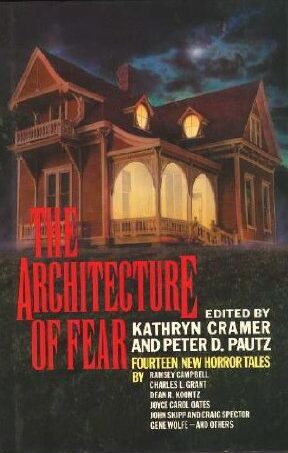
THE ARCHITECTURE OF FEAR — edited by Kathryn Cramer and Peter Pautz — is a very specific horror short-story anthology concerning architectural horror, horror that’s centered around interior structures. Take Shirley Jackson’s works, which are all classic horror texts that utilize houses in a multi-faceted way: from the looming paranormal events in THE HAUNTING OF HILL HOUSE to the decay of the protagonists’ house in WE HAVE ALWAYS LIVED IN THE CASTLE, they’re pieces where the manufactured space factor heavily into the story.
I was worried that it’d simply be back-to-back haunted house pieces, which I’m not a huge fan of, but the anthology is richer than that. The short stories range the gamut from fairy tales (Gene Wolfe’s IN THE HOUSE OF GINGERBREAD) to meditations on barroom masculinity (John Skipp and Craig Spector’s GENTLEMEN), then leaping to chewing over forbidden, abandoned spaces (naturally, Joyce Carol Oates’ HAUNTING), then mulls over a funeral home worker dealing with the presentation of a corpse (Michael Bishop’s IN THE MEMORY ROOM).
It’s a surprisingly eclectic and substantial collection, and definitely one of the best horror anthologies I’ve read since the iconic BORDERLANDS anthologies. (Fun fact: THE ARCHITECTURE OF FEAR pre-dates them, and the BORDERLANDS anthologies are currently being re-issued! Sadly, not re-issued with the original Dave McKean cover art.)
Practically every story is memorable, but my favorites (including the previously mentioned shorts) were Scott Baker’s NESTING INSTINCT, which captures the odd feeling of settling into a foreign abode, and Jessica Amanda Salmonson’s THE HOUSE THAT KNEW NO HATE, which closes out the anthology, and subverts a lot of haunted house tropes. It reminded me a bit of the classic film THE ENCHANTED COTTAGE.)
Cramer & Pautz really swung for the fences with this anthology, and it shows with their respective afterword and foreward. This is an anthology that takes horror seriously, and gives the reader an exceptional collection of works that, while framed around interior spaces, encompasses a broader area of humanity.
I first read Caitlín R. Kiernan via their excellent weird fiction tale THE RED TREE, and recently read praise for their novella AGENTS OF DREAMLAND, the first in a Lovecraftian/SCP Foundation-adjacent trilogy called TINFOIL DOSSIER. Upon finishing it, I was impressed by how stylistically it differs from THE RED TREE, and how ornate it is while being immensely agreeable. The novella consists of multiple point-of-views regarding a mysteriously horrific incident that involves a cultish leader.
While AGENTS OF DREAMLAND intriguingly sets up the crisis and builds out the agency investigating the issue, it’s slightly disappointing that it’s ultimately a prologue, and fizzles well before the end. While I’m excited to read the rest of the trilogy — the last in the series was published in 2020 — DREAMLAND doesn’t quite satisfy as an individual work. I will fully grant that I should not expect it to — while I haven’t read the other two books, I believe it functions exactly as Kiernan intended — however, when I initially tucked into it I didn’t quite realize that was the goal, and felt slightly disappointed with the conclusion.
To riff on the ‘it’s not a season of TV, it’s a 12-hour movie’ sentiment, the TINFOIL DOSSIER series is not so much three novellas, but a three-part novel.
I discovered the novel CURIOUS TOYS via a ‘most exciting upcoming horror novels in 2019’ post and was immediately gripped by the fact that it took place in 1915 Chicago and featured carnival workers. Buy me a ticket for that ride!
Upon reading it, it brought back memories of Lauren Beukes’ THE SHINING GIRLS (finally being realized as an Apple TV+ mini-series after many setbacks, under the title SHINING GIRLS). Both take place in old Chicago, both feature a predatory serial killer who kills young girls/women, and both have far more to say about women living in Chicago than to be victims, and both are well-worth your time.
(That said, CURIOUS TOYS isn’t nearly as high-concept as THE SHINING GIRLS, but to explain why would wade into spoiler territory, and I’ve digressed enough.)
CURIOUS TOYS starts off in Little Hell, a.k.a. Little Italy, a section of Chicago mostly ruled by the ‘Black Hand’ mafia. If you’ve seen CANDYMAN (the original — I can’t vouch for the latest as I have yet to see it) then you’ve seen the locale of Little Hell, as the Cabrini-Green projects were built there. If you’re wondering, Little Hell was named that because of the monstrous industrial factory there that lit up the horizon like a nightmare, and was often used by the Black Hand to incinerate bodies.
14-year-old Pin is a young, headstrong, burgeoning but confused queer girl, moved from Little Hell to live in a shack on the Riverview Park carnival, passing the summer until Pin can enrole in high school. Her stern, young mother has wrangled a job as a fortune teller, and dresses Pin as a boy ‘just until it’s safe.’ Pin does odd jobs for the ‘She-Male’ carnival performer Max (barkers declare him as ‘half-man/half-woman’), mostly delivering drugs to Chicago’s nascent film production studios, including screenwriter Lionel who works at Essanay Studios, which briefly produced many of Chaplin’s early films.
One day, Pin witnesses a girl a few years younger than her jump in a boat for the ‘Hell Gate’ water ride with an older man. She sees the man return solo, and she investigates the ride and finds the dead girl’s body.
What follows is a trifurcated detective fiction story, featuring real Chicagoan outsider artist Henry Darger — who has tasked himself with overseeing the girls in Riverview Park — and ex-detective, current Riverview Park muscle Francis Bacon (no relation to the artist), and Pin trying to track down this killer of girls.
Despite the fact that author Elizabeth Hand lives primarily in Maine and London, this is a surprisingly in-depth historical detective fiction novel that does right by Chicago. I’m familiar with the Riverview Park because of the old Riverview Tavern that was located by Roscoe & Damen. The Riverview Tavern not only had great burgers, but they also had a ton of Riverview Park memorabilia artfully placed around the significantly sized pub. (Sadly, they closed a few years ago. Hopefully they found a good home for the memorabilia.) While the Riverview Park was centrally located at Roscoe & Western, it took up a surprisingly large area of northern Chicago while it was active, until it closed in the mid 1960s.
As you may have guessed by some of the quoted terminology used above, some elements of this story may be problematic. I can’t go into most of them without delving into spoilers, but I believe Elizabeth Hand does attempt to contextualize them, but I feel the need to note it. (I’m not the only one to question this: if you aren’t afraid of spoilers, see https://www.npr.org/2019/10/20/771315664/curious-toys-gets-itself-into-unnecessary-trouble )
That aside — and that’s a pretty big unspoken matter to set aside but, chances are, if you’re reading this and would be upset by it, you know what I’m talking about — it’s an exacting, thrillingly, plotted tale about the city I hold dear, and the city I love to learn about, and I especially appreciated the epilogue, but I wish the author had handled the crux of the book differently.
If you’d like to know more: Chicagoan mystery novelist Lori Rader-Day (UNDER A DARK SKY, -also- well-worth your time, and the author of the upcoming DEATH AT GREENWAY) interviewed her during the CURIOUS TOYS press tour.
I haven’t read all that much from Joan Didion — I loved PLAY IT AS IT LAYS and enjoyed select essays I’ve stumbled over through the years. I’ve seen PANIC AT NEEDLE PARK, read a couple of other novels, and watched the recent doc on her. In other words, I’m not extremely well-versed with her work, but I am familiar enough to know when a writer has clearly been influenced by her.
I’ve been ragging on myself as of late for my absolute inability to read influential works in any proper order, and I’m especially kicking myself here regarding SLOUCHING TOWARDS BETHLEHAM — a collection of previously commissioned essays — which I explicitly picked up because Emma Cline (THE GIRLS, DADDY) lists it as one of her favorites.
It features Didion penning a number of deep-dives into classic Hollywood, just as the studio system is beginning to crumble. (She has a singular essay about how Howard Hughes represents America and I’m absolutely shocked it wasn’t mentioned in Karina Longworths’ recent opus regarding him, SEDUCTION.) She interlopes on the set of John Wayne’s THE SONS OF KATIE ELDER. I discovered that SLEATER-KINNEY’s album THE CENTER WILL NOT HOLD has that name partially because SLOUCHING TOWARDS BETHLEHEM is Carrie Brownstone’s favorite Didion collection. (Yes, it’s technically a line from Yeats’ poem SLOUCHING TOWARDS BETHLEHEM but it’s most certainly a nod towards Didion, as she writes about the importance of the poem in the preface of her collection.)
The most surprising revelation came in GOODBYE TO ALL THAT, when Didion discusses living in New York City for eight years. Obviously, Didion’s best known for perfectly describing living in California, and I’d never suspected she’d spent such a long time away from it. I should have known, given the fact that PANIC AT NEEDLE PARK is a character piece about junkies living in NYC, but I assumed she’s spent some time living there to research a piece. Instead, she lived a long journey there in-between heading back to California.
Unlike Cline, SLOUCHING isn’t my favorite of hers, but it is up there. I imagine some of the pieces will stay with me for years, while one or two I’ve already forgotten. I’m guessing any proper Didion fan has already consumed it but, hey, I hadn’t, and it’s never too late to dive into a classic.
Predictably, I’m a big TWIN PEAKS fan, and have seen the entirety of the series and FIRE WALK WITH ME several times over, although I was a relative late-comer to the series. (I’m old enough that, when I was first watching them, it was via renting them through two-episode VHS tapes from the Hollywood Video two blocks away from my first Chicago apartment.)
The prior times I’ve seen the film, I’ve found it to be profoundly unpleasant, cruel and mostly unnecessary from a story perspective, but did believe it to be an artistic, auteur marvel. (There will be no specific spoilers in this piece regarding the series or the film, apart from Laura Palmer’s death and the fact that she was heavily traumatized so, if you haven’t seen any of it, don’t worry.)
If you haven’t seen it, FIRE WALK WITH ME scrutinizes the intense week prior to Laura Palmer’s death, the launchpad for the TV series. It doesn’t include much more than that — if you’ve seen the initial season and half of the second — there’s little you don’t already know, but director David Lynch leans into a hard-R rating intensity that is tonally brutal and bleak when compared to the original show.
When I saw it in early September 2021 — the fourth or maybe fifth time I’d seen it, but the first time I saw a projected 35mm print of it and, wow oh wow, the colors and contrast really popped and were slightly overwhelming — I finally found it to be necessary. It’s still profoundly unpleasant — even more than I remember — but I realized it’s Lynch feeling like he did Laura wrong with the TV show, his show which reinvigorated the ‘Dead Girl’ genre. (See Alice Bolin’s essay regarding TWIN PEAKS here and Bolin’s subsequent, insightful book on the subject, DEAD GIRLS: ESSAYS ON SURVIVING AN AMERICAN OBSESSION.)
As Bolin notes regarding Twin Peaks and the ‘Dead Girl’ genre in general: “[the] Dead Girl is not a ‘character’ in the show, but rather, the memory of her is.” While the show itself actively tried to demystify and complicate the idyllic memory that the residents of Twin Peaks had of Laura Palmer, it never quite succeeded in that regard, thanks to some languid plotting and how most of the details of her life prior to her murder were kept from the general townspeoples’ eyes. FIRE WALK WITH ME corrects that.
With FIRE WALK WITH ME, we live with Laura Palmer for the entirety of the film, and we are seated front-and-center to see the amount of abuse and trauma she’s had to endure, to witness her terrible and numbing coping mechanisms, and to well-up at her wilted attempts to reach out to those close to her. While Lynch unrelentingly puts Laura through the wringer, it’s to finally give Laura a voice, a scream, for her to be more than just a dead girl, to be more than a prop that sets off a number of soapy narrative devices. It’s the character profile she deserved, while also being an examination of how men take and take, and how folks often avert their eyes to exploitation and abuse.
I’ll confess that, due to watching a fully sold-out screening of FIRE WALK WITH ME while fretting about contracting a case of breakthrough COVID-19, I wondered why the hell I was attending a screening of a film that’s so focused on trauma and abuse, followed up by a Q&A with Sheryl Lee, Laura Palmer herself. The film made me feel dirty enough that the prospect of a post-film Q&A with the actor who clearly had to endure and inhabit an extraordinarily difficult performance felt cruel. However, one of the first things Lee asked of the audience was:
“How many of you out there just saw this for the first time?”
From my estimate, ~15% of the audience raised their hands, and I knew one of the people seated behind me definitely had never seen it, because 1) they said so and 2) declared that it was way darker than they expected and 3) did not want to leave because 4) they spent a lot on their tickets and 5) wanted to hear what Lee had to say, despite the dude clearly wanting to further their initial date by getting a bite to eat afterwards and 6) who asks someone out to FIRE WALK WITH ME as an initial date?!
Lee then said: “I wish I could give you all a hug!” and I realized she knew what she was getting into, and is well-versed with managing it. A lot of the Q&A circled back to simply being an actor and rolling with Lynch and his scripts. In other words: you show up and you do the work and trust the director and live with what’s on the screen.
Lastly, this screening reminded me that I picked up a copy of Courtenay Stallings’s LAURA’S GHOST: WOMEN SPEAK ABOUT TWIN PEAKS from media writer Matt Zoller Seitz’s bookstore and while I have yet to read it — it’s top in my queue — given Seitz’s quality taste, I feel secure in recommending it.
GIRL ONE, Sara Flannery Murphy’s second novel, is a multi-faceted, complex piece of feminist thriller, self-described as ‘ORPHAN BLACK meets Margaret Atwood’ which is a succinct way to label it. The story kicks off in the 1970s, where nine girls were born over time by nine women, without the need of sperm, procreating exact younger copies of themselves. However, the scientist behind this method was Joseph Bellanger, an older man with a wife and two sons, but he still felt like the nine girls were also his kin, and he wasn’t shy about showing them off to the media.
All of the women and girls live on the Homefront, a compound located in rural Vermont. One night, a fire breaks out and Bellanger and Girl Nine (Fiona) fail to make it out. All of the scientific notes — which were never shared with anyone — go up in smoke. The fire is blamed on a rabble-rousing preacher who proclaimed that this event would bring about the end of men, and said Bellanger would burn in hell. He was convicted of setting fire to the compound and thrown into jail. The women detach from each other and try to live separate lives with their daughter.
Fast-forward to 1994. Girl One, Josephine Marrow — or Josie — was the first born, and she’s had a fractured relationship with her mother, Margaret Marrow, especially after she declared to her mother that she wished to continue her ‘father’s’ work. In the midst of her exams at the University of Chicago (genre writers really love both Chicago -and- Vermont, as it seems like two-thirds of the books I read take place in either region), she hears about her mother’s home catching fire, and that her mother cannot be found. Josie sets out to locate her, which inevitably intertwines her with the other Homestead mothers and daughters on a journey of discovery.
This is not a subtle work, but it’s not meant to be. It is primarily — but not completely — focused on exploring the desperate throes of a patriarchal society when threatened. The nine girls were pilloried by many as the downfall of men and society in general, at least until Bellanger’s death. The girls — most of them women by now — still have to suffer a litany of labors at the hands of men in order to get the answers they need, and it becomes increasingly clear to Josie that they’re seen as dangerous aberrations.
Reading this over the past week, I’m obviously struck by the parallels with the enacted abortion restrictions in Texas, the power struggle and suppression and, while anyone who has been paying attention to the GOP over the the years has seen this coming, it’s heartbreaking, and GIRL ONE wrangles that frustration and anger and turns it into one hell of a well-constructed tale. (It’s worth noting that Murphy lives in Utah.)
While the prose occasionally falters, it’s thrillingly plotted. Even better, all of the women are more or less assholes in one way or another, with traits like being: aloof, vain, willful to the point of blindness, over-protective, or overly combative. No one here is quintessentially heroic, but they are human, and you root for them because you realize their flawed traits are born out of necessity. It’s a very inventive and engrossing take on, not only, the Frankenstein tale, but also witch folklore.